
Written By Gaurav Sharma
Reviewed against published public guidance from the National Institute on Aging (NIA), CDC STEADI, and NCCIH | Last updated: August 2026
After 60, walking can become surprisingly complicated. Stiff knees, reduced confidence, or the fear of losing balance can make what used to be an effortless stroll feel challenging. When everyday steps feel uncertain, many older adults naturally cut back on daily movement, which can unintentionally weaken stabilizing leg muscles over time. This is where Tai Chi walking for seniors offers a refreshing, practical alternative.
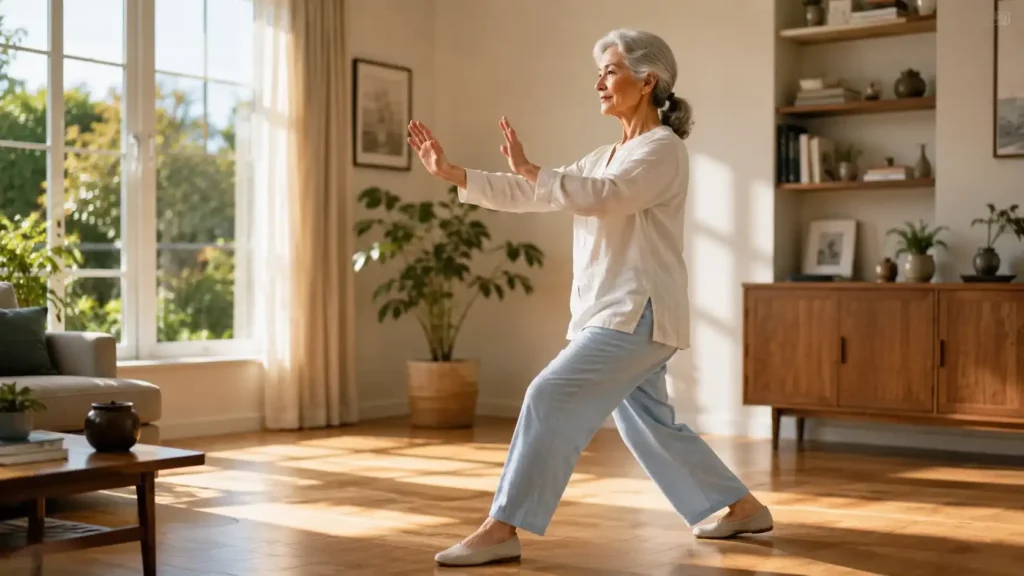
Rather than treating movement as a brisk cardiovascular race, this Tai Chi-inspired walking practice focuses on slow, deliberate stepping, smooth weight shifting, upright posture, and body awareness—without turning the session into a demanding workout.
Whenever I speak with readers who want to stay active indoors without straining stiff joints, I suggest starting with gentle footwork drills. You do not need specialized athletic gear, high stamina, or previous martial arts experience.
Here is a practical, beginner-friendly guide to practicing mindful Tai Chi walking for seniors at home, who it is best for, and how to start safely.
Table of Contents
What Is Tai Chi-Inspired Walking?
Tai Chi walking is a foundational stepping drill drawn from traditional Tai Chi movement principles. Instead of walking quickly to cover distance, your entire attention is placed on the control, balance, and alignment of each individual step.
While traditional Tai Chi encompasses various styles (such as Yang, Sun, and Chen) with different walking drills, the core principle across almost all styles centers on understanding the transition between an “empty” foot and a “full” foot:
- The Supporting (“Full”) Foot: Carries most of your body weight and maintains your balance against the floor.
- The Stepping (“Empty”) Foot: Carries minimal weight initially, allowing you to place it gently without stumbling.
Before your stepping foot makes contact with the floor, your base leg keeps your posture steady. Once the lead heel gently touches down, you smoothly roll your weight forward through the sole of your foot. This controlled sequence encourages softer foot placement that feels noticeably gentler on aging knees and hips.
📖 ALSO READ:7 Daily Habits That Help Seniors Maintain Independent Living After 60
Standard Walking vs. Tai Chi Walking
Comparing everyday walking with Tai Chi walking shows why mindful stepping is such an approachable balance drill for older adults:
| Feature | Standard Everyday Walking | Tai Chi-Inspired Walking |
| Primary Focus | Getting from point A to point B | Posture, coordination, & balance control |
| Pace | Moderate to brisk (momentum-driven) | Slow, measured, and continuous |
| Joint Feel | Repetitive impact from heel strikes | Low-impact movement with soft knees |
| Foot Placement | Quick step-through with a forward lean | Deliberate heel-to-toe roll with an upright torso |
| Support Base | Rapid weight transfer between legs | Controlled single-leg stabilization before stepping |
Key Mobility and Balance Benefits
Practicing mindful stepping for a few minutes each day provides several functional benefits for adults over 60:
- May Support Fall-Prevention Efforts: Tai Chi is among the balance-focused activities highlighted in evidence-based fall-prevention guidance for older adults, as it trains the ankles, calves, and hips to work together smoothly.
- Low-Impact Movement for Stiff Joints: Because your knees remain relaxed and slightly bent rather than locked straight, your thigh and hip muscles absorb movement forces comfortably.
- Encourages Better Posture: Keeping your spine tall and your shoulders relaxed naturally engages the deep postural muscles of your core and lower back.
- Builds Ground Awareness (Proprioception): Moving slowly helps your brain and feet better register floor surfaces, helping you feel steadier when walking on uneven terrain.
- Calming and Mindful: Coordinating slow steps with steady, relaxed breathing helps ease physical tension and brings a sense of calm to your daily routine.
📖 ALSO READ: Costco Internet for Seniors (2026): Is It Really the Cheapest Option?
Step-by-Step: How to Practice Mindful Stepping

Find a clear, flat walking space—such as a hallway, a spacious living room, or a patio—with about 10 to 15 feet of unobstructed floor.
| Step Number | Stride Step | Key Action |
| Step 1 | Set Your Posture | Stand tall with your knees soft and shoulders relaxed. |
| Step 2 | Shift Weight | Move most of your weight onto your base leg before lifting the other foot. |
| Step 3 | Take an Empty Step | Glide the unweighted foot forward and touch the heel down lightly. |
| Step 4 | Roll Forward | Smoothly transfer weight from the heel through the ball of the foot. |
Step 1: Establish Your Starting Posture
- Stand tall with your feet about hip-width apart and toes pointing comfortably forward.
- Keep a slight, soft bend in your knees—never lock your joints completely straight.
- Let your shoulders drop naturally away from your ears, let your arms hang loosely at your sides, and keep your gaze looking straight ahead at eye level.
Step 2: Shift Your Weight
- Slowly transfer most of your body weight onto your right leg.
- Feel your right foot firmly connected to the floor. Your left leg should now feel light and unweighted, ready to move without pulling your body off center.
Step 3: Take a Light “Empty” Step Forward
- Gently lift your left foot and place only the heel lightly on the floor in front of you.
- Self-Check: Keep your weight back on your supporting leg for a brief moment. You should feel stable enough that you could lift that front foot back up without losing your footing.
Step 4: Roll the Weight Forward
- Smoothly transfer your torso and weight forward, rolling from your left heel through the arch and onto the ball of the foot.
- As your left leg becomes the primary supporting leg, allow your rear right heel to naturally release from the floor behind you.
Step 5: Continue the Rhythm
- Draw your right foot forward, letting it glide gently past your left ankle, and step the right heel out lightly. Repeat this continuous, unhurried sequence across the room.
📖 ALSO READ:Free Apple Classes for Seniors: How to Master Your iPhone and iPad
Common Habits to Watch Out For
As you practice, keep these three common beginner tendencies in mind:
- Locking the Knee Joints: Stiffening your legs completely can create unwanted jarring in your lower back. Maintain a gentle, flexible softness in your knees throughout the movement.
- Leaning Your Upper Body Forward: Avoid bending forward at the waist to initiate a step. Think of your body moving forward as a single upright unit from your hips.
- Tightrope Stepping: Avoid placing your feet directly in a single straight line. Keeping your footsteps about hip-width apart maintains a wider, more stable base of support.
Gentle 10-Minute Daily Routine

Consistency is far more effective than long, tiring practice sessions. Here is an easy 10-minute sequence suitable for home:
- Warm-Up (2 Minutes): Sit comfortably in a sturdy chair. Perform slow ankle circles in both directions, roll your shoulders backward, and take five calm, deep belly breaths.
- Forward Mindful Walking (5 Minutes): Take 6 to 8 slow, deliberate steps forward down your hallway. Turn around slowly and walk back, focusing entirely on soft heel landings and gradual weight shifts.
- Supported Balance Shifts (2 Minutes): Stand near a wall or kitchen countertop for light fingertip support. Gently shift your weight from your right foot to your left foot and back, holding each side for 3 to 5 seconds to build single-leg stability.
- Cool-Down (1 Minute): Stand comfortably in place, rest your hands gently over your lower abdomen, and take three slow, calming breaths.
Safety Essentials and Practical Footwear
- Keep Support Within Arm’s Reach: If you are working on improving your balance, practice along a clear wall, sturdy hallway railing, or next to the backs of heavy dining chairs so you can steady yourself whenever needed.
- Choose Secure, Stable Footwear: Wear comfortable, closed-toe shoes with non-skid soles that fit your feet securely. Avoid loose slippers, slick socks, or shoes with elevated, narrow heels that reduce ground feel.
- Clear Your Practice Path: Ensure your walking area is completely free of loose throw rugs, electrical cords, pet toys, or clutter.
- Listen to Your Body: If you experience any dizziness, sudden joint discomfort, or shortness of breath, pause immediately and take a seat in a safe chair.
📖 ALSO READ: 10 Easy Chair Yoga Exercises for Seniors: Safe & Simple Routine at Home
Final Thoughts
Maintaining confidence in your balance does not require exhausting exercise routines. By practicing slow, mindful steps for just a few minutes each day, you can help support your lower-body coordination, encourage joint mobility, and protect your everyday physical independence.
My practical advice: Dedicate 5 minutes in your hallway each morning after breakfast. As the slow weight transitions become second nature, you will likely notice a greater sense of stability and ease during all of your normal daily activities.
Official Resources
- National Institute on Aging (NIA): Older Adults and Balance Problems
- Centers for Disease Control and Prevention (CDC): STEADI – Older Adult Fall Prevention
- National Center for Complementary and Integrative Health (NCCIH): Tai Chi: What You Need To Know
Disclaimer: This article is for educational and informational purposes only and is not a substitute for professional medical advice, diagnosis, or treatment. Always consult your physician, physical therapist, or qualified healthcare provider before starting any new physical exercise routine, especially if you have a history of falls, joint conditions, or balance disorders.
Educational only — not medical, legal, or financial advice. Talk to a qualified professional before changing exercise, diet, medication, or making a major purchase. After60Guide is not a medical practice.



Gaurav Sharma is the founder and lead writer of After60Guide. He writes practical, source-cited guides on movement, nutrition, home safety, and everyday living after 60. He is not a doctor, physical therapist, or financial adviser. Health and money articles are general education, checked against official public sources where relevant — not personal advice. Corrections: contact@after60guide.com