
By Gaurav Sharma | Founder & Lead Writer
Updated: October 2026. Educational only — not medical advice.
Medical Disclaimer:The movements and exercise guidelines in this article are intended strictly for educational, functional wellness, and general informational purposes. They do not constitute personalized physical therapy, orthopedic advice, or medical treatment plans. Always consult your primary physician or a licensed physical therapist before beginning any new exercise routine, especially if you have a history of falls, joint arthritis, cardiovascular conditions, or recent surgery.
Getting older does not mean you have to stop moving altogether. Your body still benefits from daily activity—it simply needs a gentler, more supportive approach.
If busy gyms, heavy weights, or long treadmill workouts feel intimidating or uncomfortable on your joints, you are not alone. Focusing on simple, easy exercises for seniors allows you to stay strong, steady, and independent without needing expensive memberships or bulky equipment.
All you need is a sturdy household chair, a clear wall space, and about 15 minutes each day. Furthermore, pairing daily movement with balanced nutrition can help support overall physical comfort—adding wholesome options from our guide on 12 Best Anti-Inflammatory Foods for Seniors helps nurture daily joint mobility from within.
Why Daily Movement Matters After 60
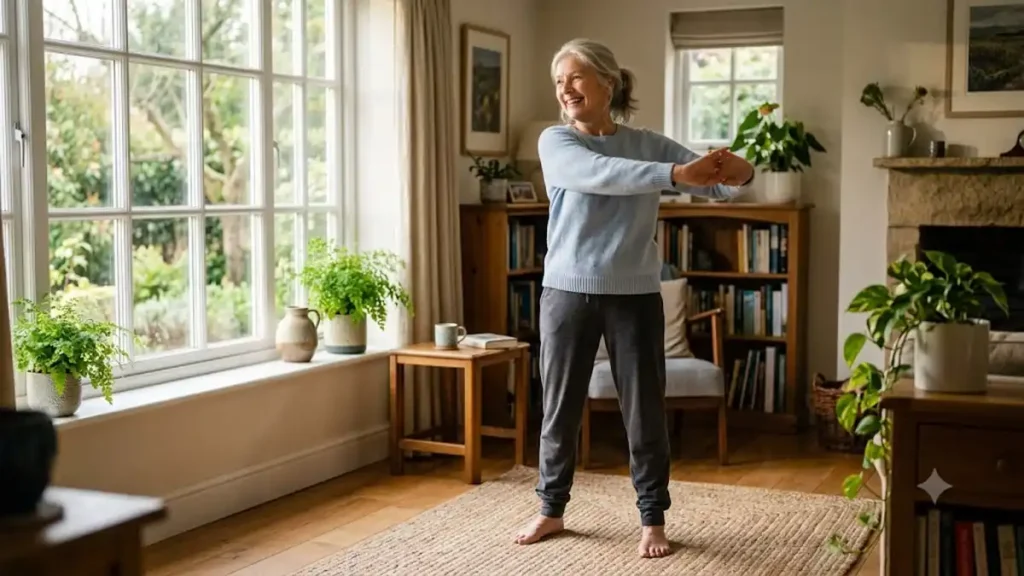
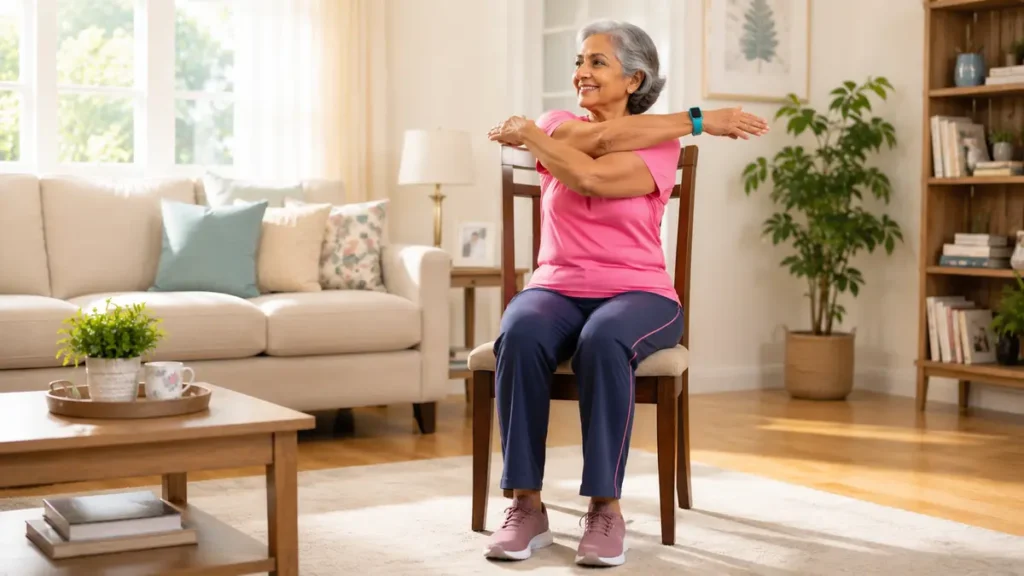
As we age, our muscles naturally lose some tone and joints can feel stiffer, especially first thing in the morning. This is a common biological shift. The encouraging news from public health bodies like the National Institute on Aging (NIA) is that regular, low-impact physical activity can slow this progression and help maintain everyday functional independence.
Here is how daily functional movement supports the body:
- Supports Joint Mobility: According to exercise guidance from the NIA, regular low-impact movement is associated with better joint lubrication and ease of movement, helping knees, hips, and shoulders feel more comfortable throughout the day.
- Helps Prevent Stumbles: Strengthening the legs, ankles, and abdominal core helps you regain balance quickly if you catch a foot on a rug or uneven surface.
- Supports Healthy Circulation: You do not need to push through exhausting cardio. Light, steady physical movement supports cardiovascular function and natural lung capacity.
- Encourages Restful Sleep & Vitality: Gentle physical activity stimulates natural endorphins, helping to clear brain fog, elevate daily mood, and promote deeper, more restorative sleep.
Organizations like the Centers for Disease Control and Prevention (CDC) and the NIA recommend that older adults include a balanced combination of balance training, functional strength, and gentle stretching each week—which this routine is structured to deliver.
7 Easy Exercises for Seniors
Before you begin, ensure you are wearing supportive, closed-back shoes with non-skid rubber soles, and choose a firm, stable chair without wheels.
1. Chair Squats (Sit-to-Stand)

- What it does: Replicates the most common movement of daily life—rising safely from a dining chair, low armchair, or car seat.
- How to do it:
- Sit toward the front edge of your chair with both feet flat on the floor, about shoulder-width apart.
- Lean your upper body slightly forward from your hips while keeping your chest lifted and head level.
- Push down firmly through your heels to rise to a full standing position without locking your knees.
- Slowly lower your hips back down into the chair with smooth control—avoid dropping suddenly.
- Repetitions: Complete 8 to 10 repetitions.
- Senior Tip: If this feels challenging initially, keep your hands on the chair arms or press gently off your thighs for support. As your leg strength builds, you can cross your arms over your chest. For fully seated routines, you can also explore our guide on 10 Easy Chair Yoga Exercises for Seniors.
2. Wall Push-Ups
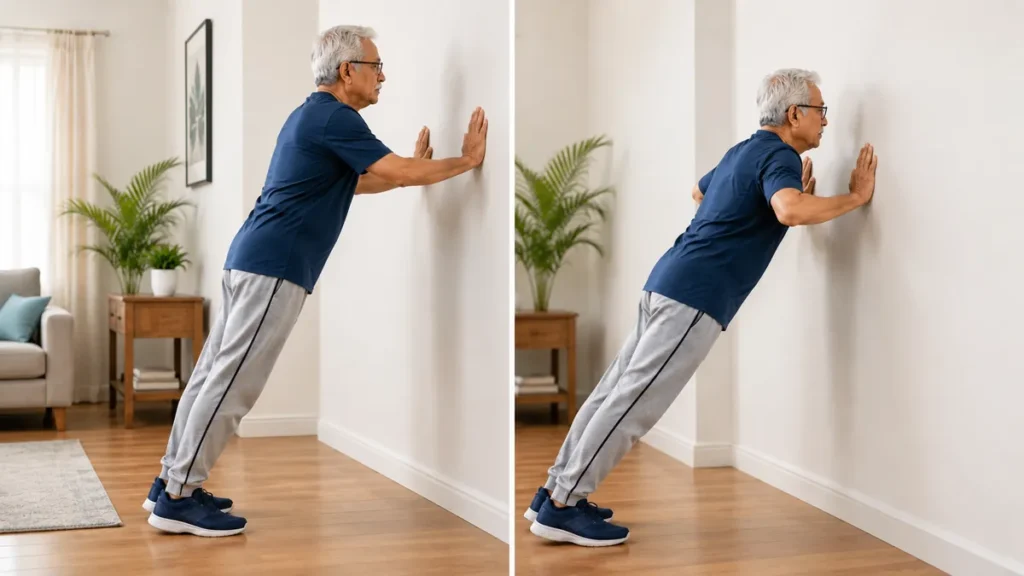
- What it does: Strengthens the chest, shoulders, and arms without putting painful pressure on the wrists or requiring floor mats.
- How to do it:
- Stand facing a clear wall, approximately an arm’s length away.
- Place your palms flat against the wall at shoulder height and shoulder-width apart.
- Keeping your heels down and your body in a straight line, slowly bend your elbows and bring your chest toward the wall.
- Press firmly through your palms to return to the starting position.
- Repetitions: Complete 10 to 12 controlled repetitions.
- Senior Tip: Standing closer to the wall makes the movement lighter. Stepping your feet a few inches farther back increases the resistance as your upper body gains strength.
3. Heel-to-Toe Tandem Walk

- What it does: Trains your nervous system, ankles, and inner ear to coordinate balance, helping you navigate narrow hallways and tight spaces steadily.
- How to do it:
- Stand upright alongside a clear wall or a sturdy kitchen counter so you have immediate hand support within reach.
- Step forward, placing the heel of your front foot directly against the toes of your back foot, as if walking on a straight tape line.
- Shift your weight smoothly to the front foot, bring the back foot around, and place its heel directly against your other toes.
- Take 10 to 15 slow, deliberate steps in a straight line.
- Safety Reminder: Keep your gaze focused forward at eye level rather than looking straight down at your feet.
4. Seated Leg Extensions
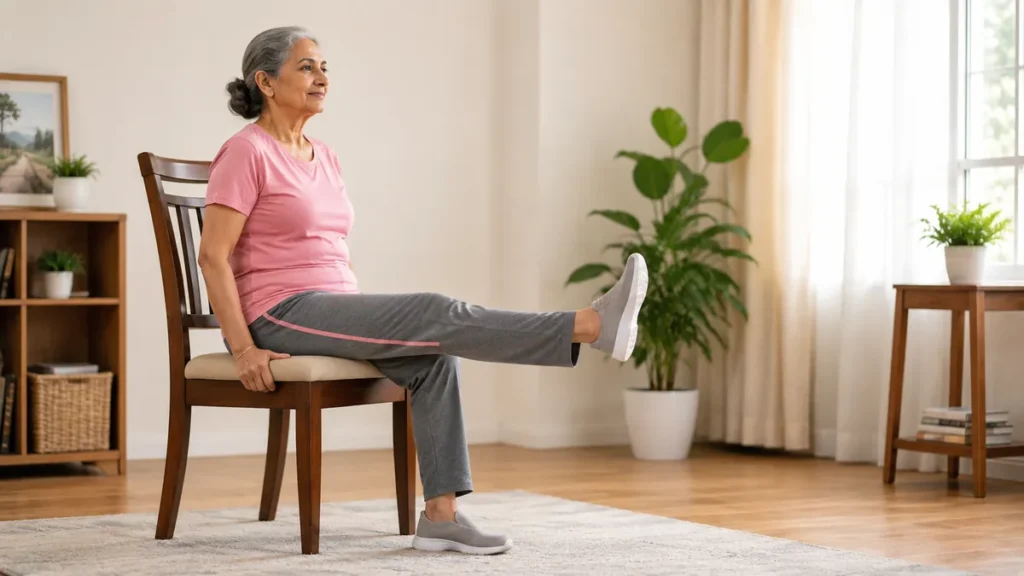
- What it does: Strengthens your quadriceps (front thigh muscles), which directly absorb impact and support knee stability when climbing stairs or walking down curbs.
- How to do it:
- Sit upright in your chair with your back supported and both feet flat on the floor.
- Slowly lift your right foot and straighten your leg out in front of you. Keep your toes pointing slightly upward toward your shin. Avoid locking your knee.
- Hold your leg extended for 2 to 3 seconds until you feel the thigh muscle activate.
- Slowly lower your foot back to the floor.
- Repetitions: Perform 10 controlled lifts on the right leg, then switch to the left leg.
5. Standing Calf & Ankle Raises
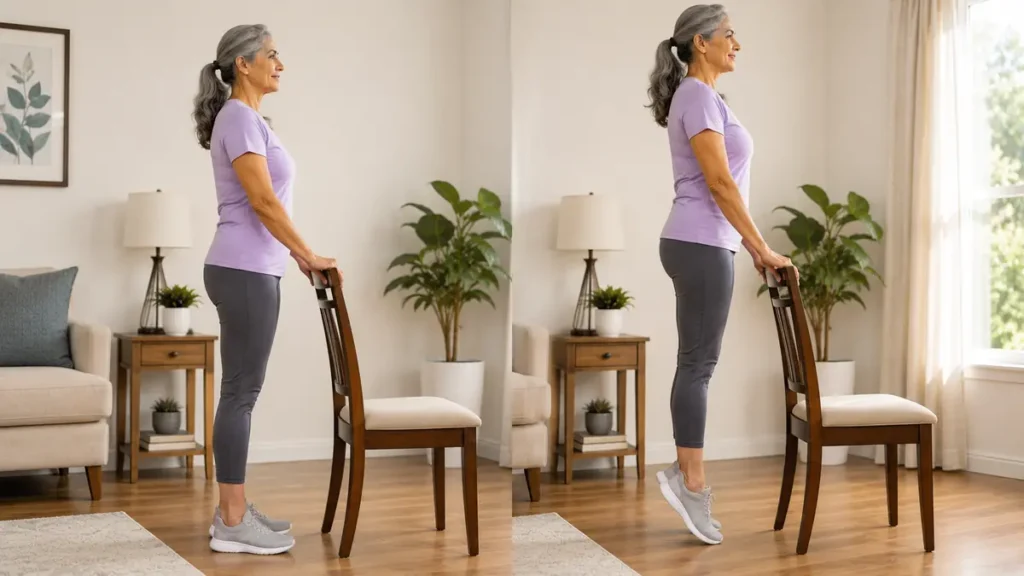
- What it does: Strengthens the calf muscles and ankles, supporting sure-footed balance when stepping over thresholds, grass, or gravel.
- How to do it:
- Stand behind a sturdy dining chair or face your kitchen counter, placing both hands lightly on the surface for balance.
- Keep your feet hip-width apart and stand tall.
- Slowly lift your heels off the floor, pressing evenly through the balls of your feet until you are standing on your toes.
- Hold the raised position for 2 seconds, then slowly lower your heels back to the ground.
- Repetitions: Complete 10 to 12 smooth repetitions.
6. Shoulder Blade Retractions (Chest Opener)
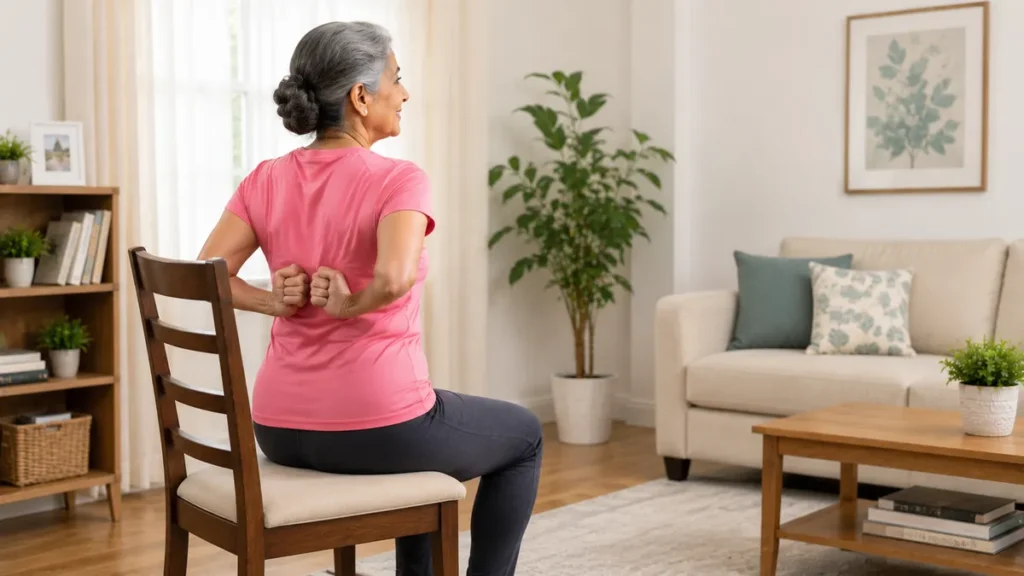
- What it does: Helps reverse rounded posture caused by reading, watching television, or desk work, expanding the chest for easier, deeper breathing.
- How to do it:
- Sit tall or stand comfortably with your arms resting naturally at your sides.
- Gently pull your shoulders back and downward, as though lightly holding a pencil between your shoulder blades.
- Keep your neck relaxed without shrugging your shoulders upward.
- Hold the gentle pinch for 4 to 5 seconds while breathing smoothly, then release.
- Repetitions: Complete 8 to 10 repetitions.
7. Seated Side Torso Stretch
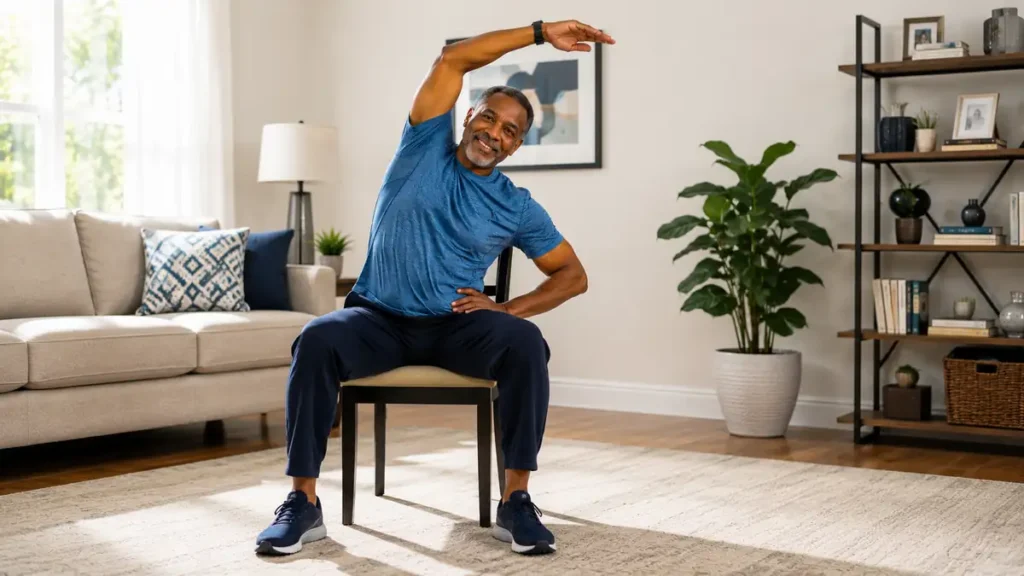
- What it does: Gently stretches the rib cage and back, making daily reaching, turning, and getting into vehicles feel more comfortable.
- How to do it:
- Sit tall on your chair with both feet flat on the floor.
- Hold the left side of the chair seat with your left hand for stability.
- Inhale and raise your right arm straight upward toward the ceiling.
- Gently lean your torso toward the left side until you feel a mild stretch along your right ribs. Keep both hips firmly on the chair.
- Hold for 15 to 20 seconds while breathing normally. Return to center and repeat on the right side.
4 Essential Safety Rules
- Wear Non-Skid Footwear: Avoid practicing standing or balance exercises in smooth socks or open-backed slides, which can slide on hard flooring.
- Breathe Continuously: Never hold your breath during movement. Inhale before moving and exhale through the effort.
- Stretch to Gentle Tension, Never Pain: A light pulling feeling in a muscle is healthy; sharp joint pinching, sudden pain, or dizziness is an immediate signal to stop.
- Keep Water Nearby: Drink room-temperature water before and after your movement routine.
A Simple 15-Minute Daily Schedule
You do not need to complete every move in one long session. Here is an easy way to organize all 7 exercises within a manageable 15-minute routine:
- Warm-Up (3 minutes): Seated side torso stretch and shoulder blade retractions to mobilize the upper body.
- Functional Strength (6 minutes): Two rounds of chair squats, wall push-ups, and seated leg extensions.
- Balance & Ankle Work (4 minutes): Heel-to-toe tandem walk and standing calf raises with counter support.
- Cool Down (2 minutes): Sit upright with your back supported, breathing calmly to finish.
Practicing this sequence 3 to 4 days per week provides noticeable improvements in everyday stability and physical confidence.
Frequently Asked Questions
What is the easiest exercise to start with if I have been inactive?
Seated movements—such as seated leg extensions and shoulder blade retractions—are ideal starting points. They engage key muscle groups and stimulate circulation without challenging your balance.
How often should older adults perform balance and strength exercises?
The CDC and NIA suggest aiming for 3 to 5 days per week, keeping sessions around 15 to 20 minutes. Short, frequent sessions are far safer and more beneficial for older adults than long, tiring workouts.
Can these exercises help reduce the risk of falling at home?
Yes. Clinical guidelines from the CDC’s STEADI initiative and research supported by the National Institute on Aging (NIA) identify lower-body strength training (quadriceps and calves) alongside sensory balance routines (such as tandem walking) as core non-medical interventions for fall risk reduction in older adults. For families evaluating additional home support alongside exercise routines, our guide on The Cost of In-Home Care for Seniors
explains common options and costs.
Do I need specialized workout gear or dumbbells?
No. Your own body weight combined with a sturdy chair and wall is entirely sufficient for building functional everyday strength.
Sources & Scientific Guidelines
- National Institute on Aging (NIA / NIH):Four Types of Exercise Can Improve Your Health and Physical Ability (Endurance, Strength, Balance, Flexibility).
- Centers for Disease Control and Prevention (CDC):STEADI Older Adult Fall Prevention & Physical Activity Guidelines.
- American Council on Exercise (ACE):Senior Fitness Programming and Functional Aging Exercises.
Medical Disclaimer: This guide is designed solely for educational and informational purposes. It is not an alternative to professional clinical evaluation or personalized physical therapy. If you have chronic joint pain, balance issues, high blood pressure, or recent surgical procedures, obtain clearance from your healthcare professional before beginning any new exercise routine.




Gaurav Sharma is the founder and lead writer of After60Guide. He writes practical, source-cited guides on movement, nutrition, home safety, and everyday living after 60. He is not a doctor, physical therapist, or financial adviser. Health and money articles are general education, checked against official public sources where relevant — not personal advice. Corrections: contact@after60guide.com